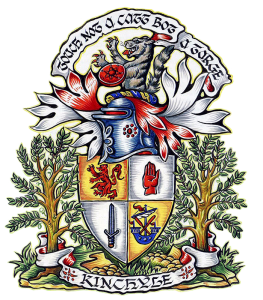
by Philip Beddows
Seanachaidh to the Chief and Clan Historian
In his ‘The Tartans of Clan Chattan’, published by the Clan Chattan Association in 2002, the late James D. Scarlett (whose wife was a MacBean) wrote: In Scottish Notes & Queries for July/August 1892, D. W. Stewart (father of D. C. Stewart) remarked upon a tartan, worn by the head of the family of Tomatin in 1872, which he described as Mackintosh with a black line centred on the main red ground, going on to say that the Chief (he meant MacBean of Tomatin) did not recognize the ‘trade’ tartan. Scarlett had found a small piece of this tartan in the Inverness Museum and described it as ‘a genuine old sett and, as such, worthy of note’. I was to discover that Scarlett had combined two entries in Scottish Notes & Queries and given the impression both were by Stewart – in fact it was the query that Stewart answered that was to prove to be the most interesting, as I will come to further on.
I thought it would be fun to see if this sample could be still found in the museum and compare it with a 100+ year old antique blanket, passed down in my family, which appeared to be of the same design. It was most probably brought back from one of his trips to the Highlands by my great grandfather Colonel Alexander McBean V.D., D.L., J.P., and is likely to be the largest piece of this old clan tartan that survives.
The quest to find Scarlett’s sample proved to be more challenging than expected. It started in January 2016 and did not conclude until Easter 2018. Knowledge of this piece of tartan had been lost at Inverness Museum, but then a new curator, Kari Moodie, helpfully found a colleague who knew of ‘a very old sample book’ that had been lying quietly undisturbed and forgotten in a vault at the museum.
I got in touch with Scotland’s finest living tartan historian, Lieutenant Colonel Peter MacDonald, Head of Research at the Scottish Tartans Authority, who generously volunteered to join my quest and see if he could locate the sample of the ‘lost’ MacBean tartan in Inverness’s collection. After liaising with the museum, a visit was arranged and Peter managed to find the ‘very old sample book’, within which he found the missing piece of MacBean tartan, long associated with Tomatin. It was a great surprise to find that it had, very appropriately, come from ‘Alexander McBean & Sons’, tailors & woollen drapers in Inverness. Newspaper advertisements in 1865, announcing the firm’s move to Union Street in Inverness, mention that ‘Alexander MacBean’ (longer form of surname used) was ‘inventor of the far-famed Highland Cloak and Deer-stalking Knickerbockers’!
Peter MacDonald reported that the piece was a soft wool type of sample, probably dating from c1880 up to 1930. He concurred with James Scarlett that the overstripe is blue. The tartan is labelled simply ‘MacBean’, with no mention of Tomatin, which one assumes meant that it was considered as the whole clan’s tartan. In the corner of the page, in much smaller writing, probably added at a later date is written ‘(MacFadyen)’ – perhaps this was a reference to the original maker or alluded to a similarity with another sett. The significant fact was that this MacBean tartan was confirmed to be an identical match to my family’s antique blanket.
However, this wasn’t the end of our discoveries about this historic MacBean tartan. Although Peter MacDonald had dated Scarlett’s piece c1880-1930, the pattern had a much older heritage.
This is revealed by the correspondence published in ‘Scottish Notes & Queries’ July-August 1892. William Munro MacBean LL.D. of New York, the great collector of Jacobite memorabilia whose extensive library and papers were donated to the University of Aberdeen and forms today’s ‘MacBean Collection’, had written to the magazine (as ‘W. M. M.’), and shared details of correspondence about the MacBean tartan between himself and Colonel William MacBean of Tomatin. Scarlett had only referred to the person who contributed an answer to this query – Donald W. Stewart, then one of Scotland’s great authorities on Tartans and author of a number of books on the topic. It was William M. MacBean of New York’s original query that was of greater historical significance.
William M. MacBean wrote:
The Macbean Tartan. — In a recently issued work by W. & A. K. Johnston, on The Scottish Clans and their Tartans, the tartan of the MacBeans is given, and may be described as a red ground with blue, green and crimson check, with white lines. Is this correct? In 1872 I wrote to the late Col. William Macbean, of Tomatin, Inverness-shire, then said to be the chief of the clan, and enclosed him a piece of tartan, manufactured by the firm of Macbean & Sons, Inverness. This tartan differed only from the Mackintosh in that the large red square of the latter had a narrow black line running down and across it, thus dividing it into four squares. The chief replied that this particular tartan was the one worn and recognised by himself as the Macbean tartan, from the fact that a very ancient piece of tartan cloth, woven in this pattern, had been found in the house of Tomatin. While the tartans are now worn on very few occasions only there ought to be no question as to the proper sett of each clan, and I think this should be of interest to Scottish Antiquarians, and a good subject for S. N. & Q. Soon the tartan will be only a memory. Logan, in The Scottish Gael, in an appendix, gives the colours, with their proportions, of a number of the clan tartans, with what degree of accuracy I cannot say, but this list might be extended.
New York. W. M. M.
D. W. Stewart responded:
The Macbean Tartan (VI., 29). — In your issue for July there is an enquiry regarding the MacBean Tartan. There is no doubt that the location of the principal families of the name was the MacIntosh country, in Atholl, at least during that period when we know that tartans were used as clan distinctions.
The MacBeans were understood to have followed the Macintoshes in their appearances in the field on all occasions; and as no trace of a distinctive clan pattern called by that name existed until the period of the comparatively recent invention of many so-called tartans, it is most probable that they wore the tartan of the MacIntosh clan, as did many other small septs in Glen Tilt.
In that most important collection of old tartans, formed by the Highland Society of London, and sealed in 1822, there is no pattern allotted to the MacBeans, although the collection includes almost all the clan patterns, nor does it occur in any of the many early collections I have had access to.
Few tartans have been more varied since the forty-five than the MacIntosh, all partaking, however, of the main features of the tartan as preserved in the fragments of the coat worn by Prince Charles Edward while in the MacIntosh country.
The collection referred to above has been kindly entrusted to me for use in connection with the publication of a work on hitherto undescribed tartans, and will prove of much interest and value as a standard authority on Clan Tartans, which are really such, and not merely fancy checks, of modern design.
Donald W. Stewart.
151 Bruntsfield Place, Edinburgh.
Despite his reputation as an authority on Tartans, Stewart had made an error – the extra stripe was not ‘black’ but dark blue, matching the rest of the blue on the tartan, precisely emulating the colour to be found on Mackintosh Tartans. The result of Stewart’s mistake can be clearly seen in the modern MacElvain tartan created by the trade, which was modelled on the older MacBean tartan, but with the black line described by Stewart. As Scarlett wrote, it may be surmised by some that the black line was a Victorian affectation in memory of the famous exploits and death at Culloden of Major Gillies MacBean, younger brother of the clan’s Chief, Aeneas MacBean of Kinchyle, but this would clearly be an incorrect conclusion in view of the line being confirmed as dark blue.
The Highland Society of London or perhaps one of the MacBeans might have seen Stewart’s comments and decided to ensure that this omission did not continue, since the Society is found to have included a specimen of a MacBean tartan in Volume II of their Collection, which was collected 1906-1934. The tartan appears in the Index simply as ‘MacBean’, again, without mention of Tomatin. Significantly, it wasn’t the modern clan tartan we know today that the Society recorded for MacBean, but the older sett that was sold by Alexander McBean & Son in Inverness and recognised by the MacBeans of Tomatin as the clan’s tartan – the same pattern found on our antique MacBean blanket. I am deeply indebted once more to Peter MacDonald for confirming the existence of this record from the collection of The Highland Society of London. We are now in touch with the Society to see if it can be discovered who provided this specimen of MacBean tartan, and further research about this old MacBean clan tartan continues.
The modern MacBean tartan originated from the famous picture of Major Gillies MacBean at Culloden, by artist R. R. McIan, for James Logan’s ‘The Clans of the Scottish Highlands’ (published in two volumes 1845-47). McIan painted Gillies wearing a kilt of Mackintosh tartan and for his hose the artist used a tartan pattern manufactured by Wilson of Bannockburn, called the ‘Birrell Sett’, and so it was that this ‘Birrell’ pattern became the model of the modern MacBean tartan.
In his 1892 query, William M. MacBean shared that the tartan worn by the Tomatin family and recognised by their head as ‘MacBean’ was the same as a very ancient piece of tartan cloth found in the house of Tomatin. It is clear that these MacBeans were wearing this tartan well before 1872. Although it does not appear in the Highland Society of London’s collection in 1822, that doesn’t confirm it didn’t exist at or before that time.
William M. MacBean had predicted that the older MacBean tartan would soon be only a memory. I am delighted to confirm how wrong he was. Memory of it may have faded, but it has now been re-found and I’m sure all members of the Clan MacBean will rejoice at this news.
It really is a wonderful thing that this sample of a genuine, historic old MacBean tartan, modelled on Mackintosh and most associated with the MacBeans of Tomatin, but not exclusive to them, has been rediscovered. It is a significant, and surprising surviving treasure of the clan’s heritage. I am enormously grateful for Peter MacDonald’s help in tracking it down. Perhaps this older MacBean tartan may be honoured by being rescued for posterity and worn again with pride alongside the more well-known, official Clan tartans.
This is an extended version of an article published in The Clan Chattan Association’s ‘Touch Not’ magazine (March 2019).
Written for publication in ‘The Clan MacBean Register’: May 2019.
Edited with corrections, February 2020: these result from the realisation that ‘W. M. M.’ was not, as assumed by one of the sources of this article, Rev William Mackintosh Mackay of Glasgow who had written to Scottish Notes & Queries from New York City, whilst staying with his brother Rev Donald Sage Mackay, but in fact the great collector of Jacobite memorabilia William Munro MacBean, LL.D. of New York (1852-1924). He was a passionate member of the Scots diaspora in North America and authored the ‘Biographical Register of St. Andrew’s Society of the State of New York’, which provided biographies of a number of MacBeans. William MacBean’s collection of over 3,000 books and other papers was donated to the library of the University of Aberdeen and forms its ‘MacBean Collection’.
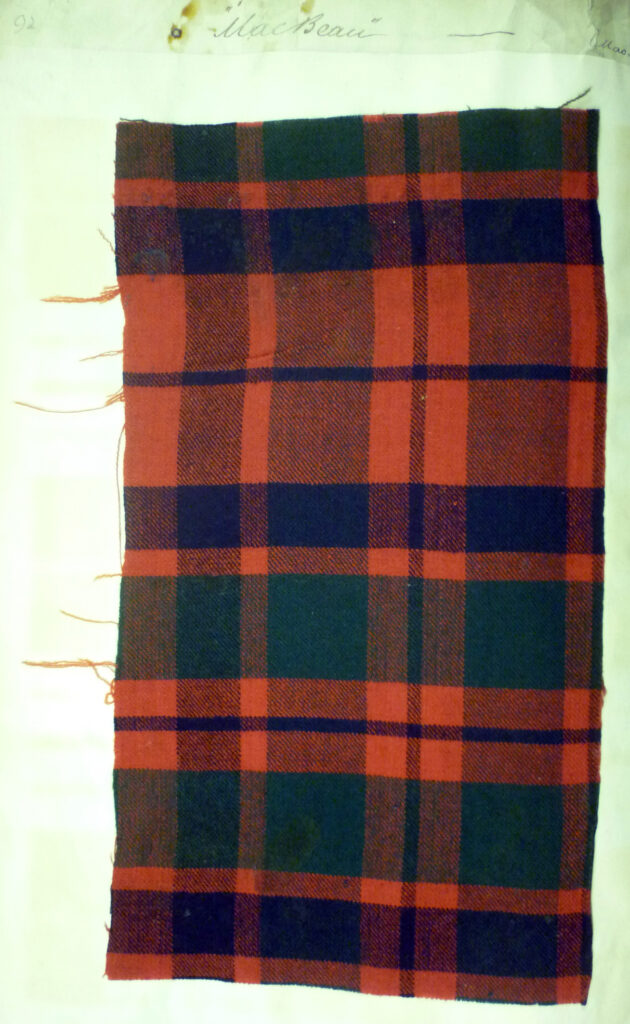
Accompanying photograph 1: The MacBean (of Tomatin) tartan in Inverness Museum – photograph by Peter E. MacDonald, published here with his kind permission.
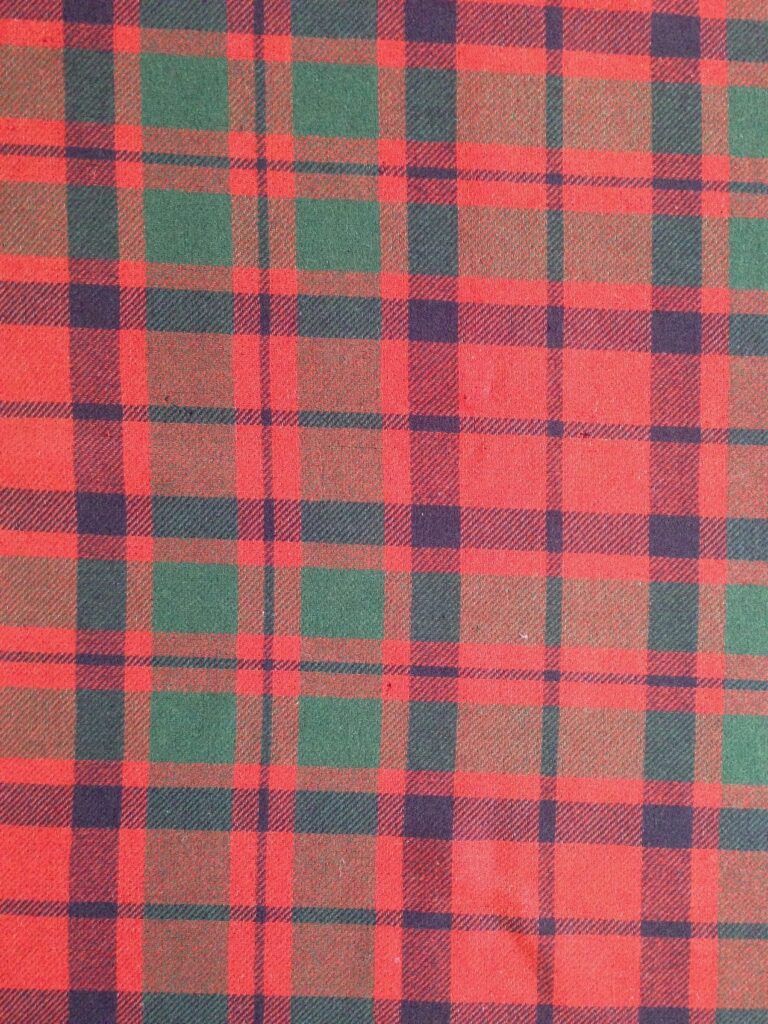
Accompanying photograph 2: A section of the MacBean (of Tomatin) tartan from the home of the late Colonel Alexander McBean of Tyninghame, Tettenhall – photograph by Philip Beddows.
Philip Beddows, May 2019 (corrected February 2020 and edited for republication 2025)
First published in The Register, Spring–Summer 2019 (an extended version of an article in Touch Not, March 2019); revised February 2020 and edited for re-publication in 2025.