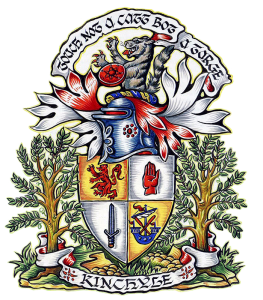
The oldest known decorative MacBean heraldry
by Philip Beddows
Seanachaidh to the Chief, and Clan Historian
& Allan MacBain
The Chief’s Representative in Scotland
Written for publication in the 2025 edition of ‘Touch Not’, the magazine of The Clan Chattan Association.
Reading through accounts of Clan Chattan’s clans, one finds references to places, knowledge of which locations seem lost to us today, artifacts that have not seen the light of day for centuries, and gravestones that can no longer be found in the Kirk graveyards where our forebears’ remains are buried. However, all is not always lost, and this short article is intended as an illustration of what may lie right beneath our feet, awaiting re-discovery.
Together, we have continued our hunt for ‘lost’ treasures and archive heritage of Clan MacBean, and this is one of the discoveries we have been making in the past few years.
A. M. Mackintosh, in his ‘The Mackintoshes and Clan Chattan’ (1903) provides a chapter covering the heraldry of the clans and families of Clan Chattan. In the section on MacBean heraldry he writes that:
In 1672 William Macbean, merchant in Inverness, obtained from the Lyon office a grant of arms as follows,— quarterly, 1 or a lion rampant gu.; 2 arg. A dexter hand couped in pale gu.; 3 arg. a sword in pale ppr. within a border indented gu.; 4 or a lymphad, oars in saltire, sable.
Although A. M. Mackintosh didn’t know who he was, The Lord Lyon in 1960 recorded he had been the 2nd son of John MacBean of Kinchyle, 10th Chief.
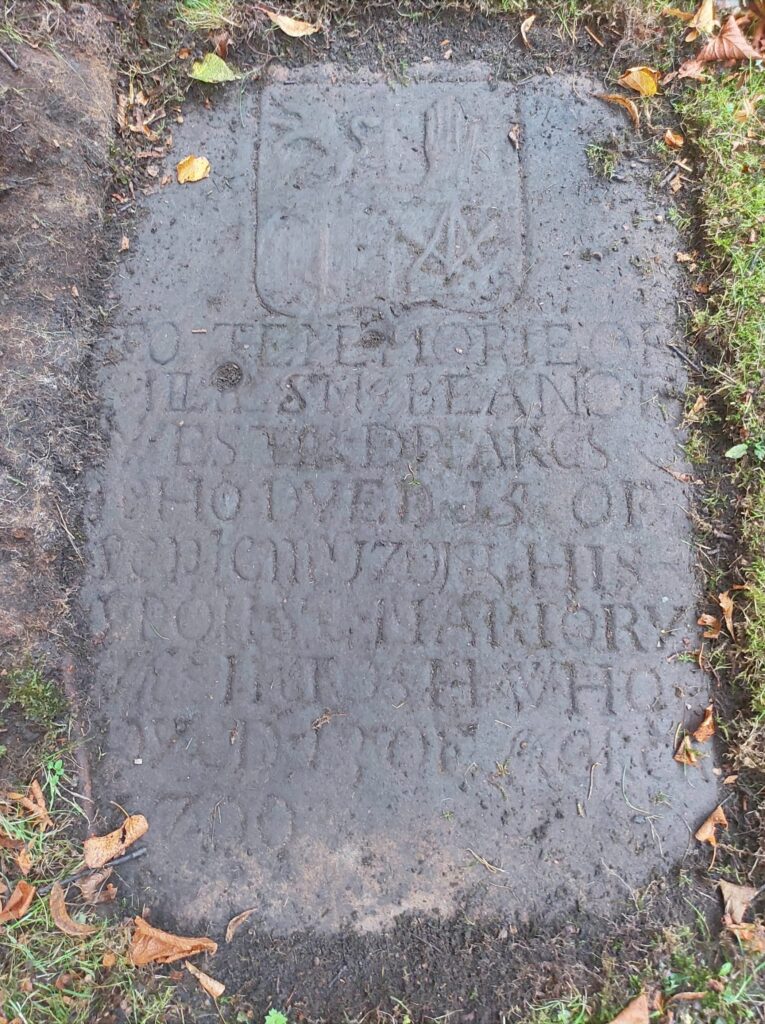
A. M. Mackintosh goes on to describe the heraldic tombstone of a Gillies McBean of Wester Drakies, who died on 15th Sept. 1701, whose coat of arms was the same as those granted to William MacBean in Inverness, with one difference – where William has in the 3rd quarter of his shield ‘a border indented gu.’, Gillies’ shield had no bordure. This Gillies – with his quintessential name found used for generations by the Chiefly line of Kinchyle – was buried in the Chapel Yard Cemetery in Inverness. A part-inscription for it was recorded, along with its approximate location, some long time ago, but since then had seemingly ceased to exist.
We decided to set out to see if it may still be there, under the turf. Using recorded and visible gravestones which surrounded the likely spot where Gillies’ grave had last been recorded, a very careful exploration of the ground was done, and a slab stone found to lie under the turf almost precisely where we had hoped. Having marked the edges of the slab, very gently and extremely carefully the turf was rolled away and revealed the splendour of Gillies’ gravestone with the heraldry perfectly preserved, exactly as described by A. M. Mackintosh, along with the inscription:
TO THE MEMORIE OF | GILLIES McBEAN OF | WESTER DRAKES | WHO DYED 15 OF | Septemr 1701 & HIS | SPOUSE MARJORY McINTOSH WHO | DYED 13 OF MARCH | 1700.
The shield is the very same design used by our chiefs since Hughston McBain of McBain (grandfather of our current chief, Richard McBain of McBain) was matriculated by The Lord Lyon, 8th March 1960, on being recognised as Chief, which with its colours is described on his Letters Patent as:
Quarterly; 1st, Or, a lion rampant Gules; 2nd, Argent, a dexter hand couped in pale Gules; 3rd, Argent, a sword in pale proper, 4th, Or, a lymphad Azure sails furled proper, oars in saltire Gules and flagged of the last.
Having inspected the tombstone of Gillies McBean of Wester Drakies, and taken photographs, the turf was again very carefully rolled back over the top and the grass settled back where it had been. This left the stone safely preserved, protected from erosion and any damage caused by people walking on it. Sadly, we saw examples last summer, at Petty and Dores, of gravestones on the ground that had turf pulled back, messily, in clumps, and not put back in place. If any reader is considering a similar exercise, we would urge them to approach it with considerable care, and without the use of any metal object. A wooden stick can help find stone under the grass, and fingers, flat wood and plastic can help tease the turf back. Readers may be interested to note that the Highland Family History Society has a collection of memorial inscriptions and some photographs: www.highlandfhs.org
One wonders what other heritage treasures may also lie just beneath our feet, not lost at all, but simply slumbering, protected by the soft turf above. Lachlan Mackintosh of Kinrara recorded (in 1680) that the body of William Mackintosh, son of Angus and Eva, was taken from Petty, to the burial island on Loch Arkaig, where he had desired to be buried: ‘in the year 1368, and his tomb is to be seen there to this day’. Although this (along with other ancient tombs), has vanished from memory and sight long ago, it may still lie there, awaiting for us to re-discover it.
Written for publication in the 2025 edition of ‘Touch Not’, the magazine of The Clan Chattan Association.
First published in Touch Not, the magazine of the Clan Chattan Association, 2025.