High on the hill above Dores, looking down Loch Ness, there is a little park with a stone wall, two wildcats, and a gate that says Kinchyle. It is only about two acres. My grandfather built it, my father kept it alive for decades, and in 2013 he handed it to me.
Kinchyle was the home of our chiefs for centuries and the battle cry of our clan. We lost those lands in 1760, after Culloden. The park is the one piece of Kinchyle that is ours again: a place where anyone carrying the name MacBean, McBain, Bean or any of its spellings can come and stand on the ground of their ancestors.
Its story is long and has a few villains in it. Here it is, from the beginning.
— Richard McBain of McBain, 23rd Chief


In September 1958 my grandfather, Hughston McBain, petitioned the Court of the Lord Lyon to be recognized as Chief of the Clan MacBean. He was the first of our chiefly line born in America (Grand Rapids, Michigan, 1902), and he became the 21st Chief.
The Lord Lyon, Sir Thomas Innes of Learney, wrote to him that October with a piece of advice. My grandfather told the story himself:
“He expressed the hope that I would buy some land in Scotland. Said it wasn’t required, but that Scots ‘looked down their noses’ at landless chiefs. I agreed to do so.”
The Lord Lyon’s letter of 21 October 1958 was more specific: he hoped my grandfather would “repurchase Kinchyle, which is near Scaniport.” A cousin in Canada, Stewart McBain of Glen Bain, Saskatchewan, stepped aside in December 1958, and on 27 January 1959 the Lord Lyon confirmed Hughston as Chief.

He went to the Map Room of the National Library in Edinburgh, found maps drawn at 25 inches to the mile, and traced our ancestors’ lands two miles along the shore of Loch Ness near Dores. “I decided then and there that I wanted part of those old family lands!”
Buying them was another matter. His Inverness solicitor, Athole Mackintosh, tried for almost two years. He had hoped for a hundred acres or more; the owner, Baroness Burton (widow of the Bass Ale family), would not sell at any price. In the end she offered a “wee piece” of about two acres up the hill from Dores, near the manse, for about $48. My grandfather turned it down as an insult. His lawyer told him to take it, build something attractive, and perhaps she would sell more. The deed forbade any commercial use: the locals were sure the American wanted to open a hamburger stand.
He hired an Inverness architect, Ian Monro, with an unusual brief: “build a Memory Park that wasn’t a cemetery.” Monro fenced the ground with rock posts at the corners, hung a wide iron gate bearing the clan wildcat and the word Kinchyle (with a turnstile, to keep the sheep out), and laid gravel paths up the hill. In the high corner he drew a stone cairn with three wings; my grandfather cut it to two. D.A. MacKinnon of Howden & Co. planted a heather garden that grew to twenty varieties, and a grove of boxwood, the clan’s plant badge, from which visitors were invited to take a sprig. By March 1960 the Lord Lyon’s certificate of recognition could already describe my grandfather as “holder of part of his ancestral lands of Kinchyle.”
Set into the cairn went a bronze plaque, cast in Edinburgh:
Dedicated to the memory of the Clan MacBean (MacBain) of long ago, whose ancient chiefs once owned extensive lands in the area. On 15th September, 1610, MacBheathain himself — Angus MacBean of that ilk, Paul, vic William, vic Gillies, vic Paul — 10th Hereditary Chief of Clan MacBean, obtained in feu from Sir John Campbell of Cawdor those lands of Kinchyle, which had been held by his father, Paul MacBean, 9th Hereditary Chief, from before 1568. Erected 1961 by Hughston McBain of McBain, 21st Hereditary Chief of Clan MacBean.
On each wing of the cairn sat a bronze wildcat: “wild-catts guarding the cairn,” as my grandfather captioned their photograph. The park was finished in the summer of 1961. On a clear day you can see the whole twenty-mile length of Loch Ness from it.
The trouble started almost at once. Within a year or two visitors were taking cuttings of the heather, and sometimes whole plants. White heather was the favorite, because it is said to bring luck. My grandfather replanted and put up rhyming signs with a light touch. By his own count they cut the pilfering by about eighty percent:
McBain Memorial Park — No Burial Ground — No Bodies Around — Just Fond Recollections — Ancestor Connections
We love it here — Please let us stay — We want to cheer you — On your way
Let me be, I’m just a wee tree!
The park drew visitors from the start. The Scottish Tourist Board asked for 20,000 copies of a little card with the map to the park.
It took two more years to get permission from the council for a road sign on the Dores road, and it went up in 1963. Around 1962 someone photographed my older sister, Christina, standing beside it as a little girl. Keep that photograph in mind; it comes back into the story fifty-seven years later. The sign did not last. It was gone within a few years, and so was the replacement my father put up. For the next half century, finding the park meant asking at the Dores Inn.
The park was designed to look after itself, and for a while it did. By the mid-1970s it was looking scruffy, and my grandfather had the original builder give it a thorough cleanup shortly before he died. After that it was my father’s.
James McBain of McBain, the 22nd Chief, ran a photography business in Tucson, Arizona, and looked after a Highland park on the other side of the world for more than thirty years. He and my stepmother, Peggy, known to everyone as Lady Peggy, cleared it with their own hands in the summer of 1982. He hired a neighboring farmer, Mr. MacKenzie, to tend it a few hours a month, and left a set of clan garden tools with Mrs. Lowe at the old manse below the park for any visitor who felt like doing more than tidying up.
Scotland fought back. Bracken, with stems as thick as a man’s wrist, smothered the heather. Gorse (the locals call it whin) closed the paths with its spines. In the summer of 1999 my father found the heather garden gone, the gate rusted away, the fence down with the neighbor’s cattle wandering through, and the flagstones at the monument loose underfoot. He hired Aitchison of Inverness to rebuild the fence, clear the paths and re-set the stones, and by summer 2000 the park was “once again in condition to receive visitors.” Mike Crummey of Tomatin oversaw a new gate, and Charles MacLennan of Inverness and his four boys helped keep the paths open.
In July 2006 my father and I went over together to see how it was holding up. The gorse was winning again, and someone had taken a hammer to the new gate and broken its lock. Ella MacRea at the Dores Inn, who keeps the clan’s visitors’ book, lent us one of her young staff, Colin MacArthur. He pulled the gorse out by the roots and burned it in the parking area, and Mike Crummey came back to mend the gate.
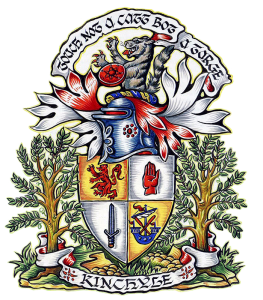
The wildcat is the badge of Clan Chattan, the “Clan of the Cats”, and Clan MacBean has been part of Clan Chattan since the marriage of Eva, its heiress, to Angus Mackintosh in 1291. Our crest is a wildcat holding a targe, our motto is Touch not a catt bot a targe, and our chiefs signed the Clan Chattan bonds of 1543 and 1609. The two cats on the wall at the top of the park are not decoration. They are the clan standing guard over its own ground.
Which is exactly why someone wanted them.
The architect had assured my grandfather that no one could steal the cats: each was fixed by a six-foot rod running from its belly down through the stonework into the ground. In August 1994 thieves proved him wrong. They broke apart the wings of the wall to pull the cats out whole, and the theft was found around the first of September. When the clan tour arrived the following summer, my father met them at the park holding one of the broken stones. The Roberts Family Reunion in Southwick, Massachusetts, heard the news and voted that same week to send money for the repairs; they kept giving for years.
The plaque survived that theft, and survived for seventeen more years. Then, early in the summer of 2011, it was gone too, almost certainly for the value of its bronze. Of everything my grandfather put on the hill, the plaque had been one of the last pieces that made it the McBain Memorial Park. Without it, the park was on its way to becoming a memory: a place where clansfolk used to go. The clan office, under Gene Moeny, opened a Park Fund that summer, and in September 2011 Jock Binnie confirmed that gifts to it were tax-deductible.
In 2013 my father asked me to take on the park. He was in his eighties and I was his Tanist. I said yes, and for the next several years I went to Scotland every summer.
The first rule was simple: nothing on that hill would ever again be worth stealing for scrap. In Tucson I worked with Moira Geoffrion, the sculptor and former head of the University of Arizona art department, on a new plaque and a new pair of wildcats, cast in resin mixed with bronze powder, so they look like bronze but have no scrap value. The plaque cost just over a thousand dollars; in real bronze it would have been three times that, and each cat another two thousand. Lisa wrote a small sign for the park to tell would-be thieves exactly that:
Bronze, brass of worth money I am not.
Leave it to a frugal Scot.
So steal me not, lest you be cursed
and die amongst all kinsmen first.
The new plaque came home on 6 June 2014.
The cats took longer. While they waited to go up, Celia Mackintosh of Moy Hall kept them, and the plaque, safe at Moy, which seemed fitting for the cats of Clan Chattan, and she put me up through the whole of the work. Jude Mackenzie, who runs the Flagstaff Highland Games, took the fundraising on as a personal challenge in my father’s honor and dared the other Arizona games to match Flagstaff’s gift; they did. And it was Lisa’s idea to travel light, very light, so that the cats could fly to Scotland as our luggage.
In the last days of July 2016, Paul Torode of YourLandscaping in Inverness cleared the gorse, fixed the cats onto the wings of the cairn, and laid two tonnes of fresh gravel. On Saturday 6 August 2016 we rededicated the park. Col. Pete McIllwain brought twenty-two members on the clan’s first official tour of Scotland, from Australia, Canada and the United States, and more than fifty people climbed the hill. The road is so narrow that the tour coach could not manage the last mile, so Allan MacBain and others ferried everyone up in their cars. Piper Cindi McIntosh-Behr played us in with Highland Cathedral. Our chaplain, Rev. Dr. Jan Womer, rededicated the park “in memory of the Clan MacBean of long ago.”
Then I opened a bottle of Tomatin, poured it into wee cups, and declared it the clan’s whisky, for the moment anyway. We toasted the new cats on their wings of the wall. I held my hand over their heads and wished them another fifty-five years free of vandals, and I offered them a sip. They were on guard duty, and declined.

Remember the photograph of my sister Christina beside the road sign, around 1962? When I set out to put a sign back on the Dores road, the rules had changed in the fifty-odd years since. Alistair MacLeod, Principal Technician at the Highland Council, found a way through. In 2016 he wrote to me:
“A modern-day directional sign would need to fit within certain set standards. As a compromise, we would be content for a sign, similar to that shown in the photo supplied by you, to be erected at the rear of the verge next to the field boundary fence.”
Similar to the photo. Luckily, the picture of Christina was in good focus. I enlarged it, traced the demi-cat on top of the post to make a template, and Norisign in Glasgow did the rest. The new sign is all aluminium on a solidly anchored post, and if you notice how much it looks like the original, that is no accident. It went up in March 2019.
Thanks go to Allan MacBain, our UK genealogist, who put me in touch with Alistair, and to everyone who gave to the Park Fund.
In November 1969 Captain Alan LaVern Bean, US Navy, became the fourth man to walk on the Moon. Tucked in his personal kit on Apollo 12, and carried down to the lunar surface in the lunar module Intrepid, was a piece of MacBean tartan. As far as anyone knows, no tartan has traveled further. Years later, as a painter, he gave the clan his painting Clan MacBean Arrives on the Moon, with a cutting of that tartan on its frame.
Alan Bean died on 26 May 2018. That October, at the clan Gathering at Stone Mountain, Georgia, the board proposed a memorial to him in the park, and on 4 January 2019 we agreed the plan. For the first time since my grandfather built the park, we would not be restoring something that had been taken. We would be adding something new. The first idea was a great concrete moon. By late 2019 it had become a stone-clad pillar carrying printed metal plaques: sculptors had not followed through, and anything in bronze would only invite the thieves back. Thirty-nine donors had given nearly $9,000 by October 2020.
It turned out to be the hardest part of the whole project. Construction began on 7 March 2020. To get equipment in, the stonemason took down one of the two pillars of the entrance gate. Less than four weeks later, on 2 April, Scotland went into lockdown and all work stopped. The dedication, planned for August 2020, moved to August 2021. Then the stonemason lost interest, and for more than a year the park sat with half its gateway on the ground, looking abandoned.
Once again a clansman stepped up. John MacBain, a landscaper in Inverness and brother of Allan, took charge on the ground, and found a local stonemason, Antony Swan. The two of them rebuilt the gate pillar, rehung the gate, raised the wall along the drive, clad the memorial in black sandstone, built two new benches, and did work on my grandfather’s monument further up the hill. They finished on time and within budget. One of the benches is dedicated to them, with a “Goldilocks” poem by Lisa on its plaque thanking Antony, John and Grant Napier. Antony looks after the park to this day.
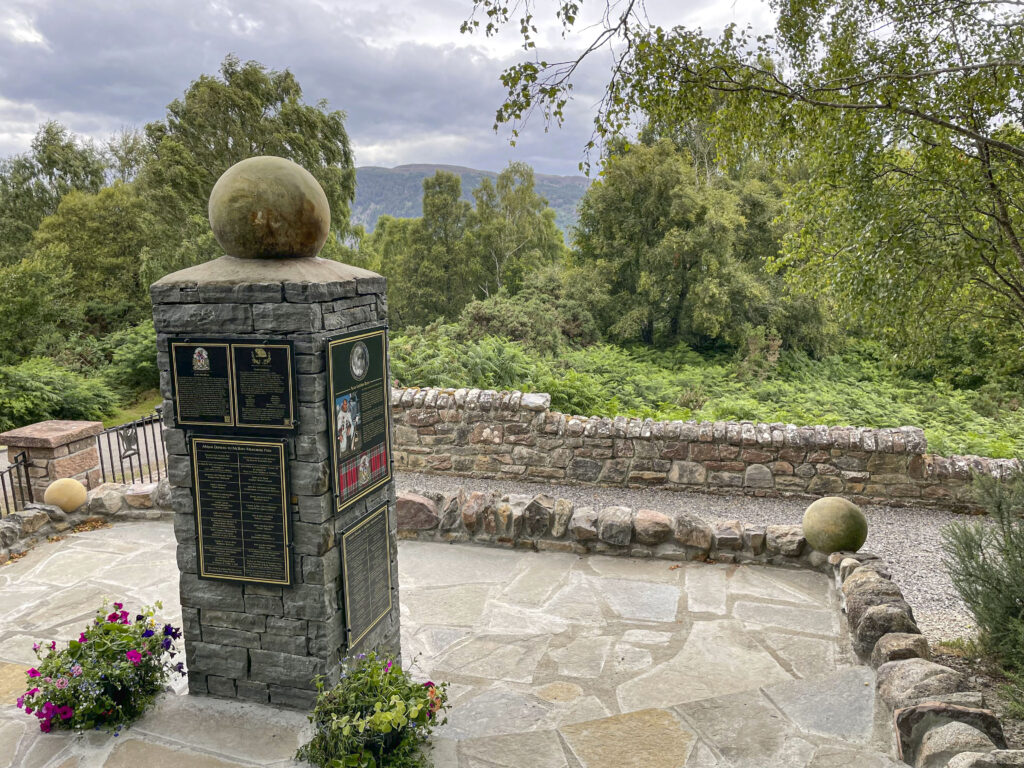
The memorial stands just inside the gate, on a flagstone terrace looking out over the trees towards the hills across Loch Ness: a square pillar of dark dry-stone, crowned with a great stone sphere for the Moon. On its faces are the plaques of the Clan MacBean and of Clan Chattan, each with its arms; the story of Alan LaVern Bean and the Moon tartan, beside a photograph of him in his spacesuit and a band of MacBean tartan; and two plaques naming the major donors to the McBain Memorial Park. Smaller stone moons sit on the low walls around it.
My father died on 7 March 2022, at ninety-three, the longest-lived and longest-serving chief in our history. In that moment I became the 23rd Chief. As I told a reporter that summer, “It’s a day you know is coming, in my case since I was born.” Five months later we gathered on the hill to dedicate the Alan Bean Memorial and to inaugurate me as Chief, by the monument my grandfather built.
It rained right up until we started, and the wind was strong, but about seventy people climbed the hill. Cars lined the narrow road, and local cyclists stopped to watch.
The procession. We marched in behind our piper, Stewart McBain, playing “The MacBain March” and “Badge o’ McBain”, tunes written for my grandfather that I don’t believe had been played since the 1970s; I had found them in my father’s papers. Mike Smith and Paul Macdonald carried the swords, Allan MacBain the guidon and Mark Bean the flag. That day Stewart was appointed the Chief’s Piper.
The guests. The Rt Hon. the Lord Lyon King of Arms, Dr Joseph Morrow, oversaw the day as the representative of Her Majesty Queen Elizabeth II. With him were John Mackintosh of Mackintosh, President of Clan Chattan; Iain MacGillivray, Commander of Clan MacGillivray; Councillor Ian Brown, Leader of Inverness & Area; Lt. Col. Peter MacDonald, the tartan historian; and the Very Rev. Allan Maclean of Dochgarroch, our chaplain for the day. The master of ceremonies was Philip Beddows, Clan Historian and my Seanachaidh, the keeper of the chief’s genealogy.
The dedication. We first dedicated the memorial to Alan Bean. We played a recording of his daughter, Amy, speaking about her father and the clan, ending with the prayer he left every audience: “Light to thy path, wind to thy sails, dreams to thy heart.” Major Scott McElvain read the address of our President, Col. Pete McIllwain. Lisa spoke of her own work on the Cassini and Mars missions, Councillor Brown spoke for the city, and Iain MacGillivray piped “Top Gun” and the American national anthem for the fourth man on the Moon.
A new tartan. Peter MacDonald explained what he and I were wearing: the first kilts in the new MacBean Hunting tartan, which he and Philip designed and Lochcarron wove. It was the last project my father and I worked on together.
The inauguration. The Lord Lyon explained that his office has its roots in the old Celtic tradition of the high seanachaidh, who stood at a king’s inauguration to recite his genealogy and so prove he was the rightful king; a chief, like the King of Scots, is of his people, and his first duty is to serve them. Then Philip proclaimed my ancestry before the clan and our kinsmen of Clan Chattan, first in Gaelic and then in English:
Ruiseart, Mac Seumas, Mhic Uisdein, Mhic Uilleim-Frederick, Mhic Uilleim, Mhic Alasdair, Mhic Uilleim, Mhic Fearchar, Mhic Iain, Mhic Uilleim, Mhic Phàil, Mhic Iain, Mhic Aonghais, Mhic Phàil, Mhic Uilleim, Mhic Gilliosa, Mhic Phàil — bho gineal Maolmoire, Mhic Beathan Mór, Mhic Maolmoire bho Clann Chatain
The Lord Lyon put three questions to me: did I confirm that I am the rightful chief of this clan; did I promise to protect and serve the clan; and was I willing to take the responsibilities of chief of this ancient clan. I answered that I do, and that I am. Then he asked everyone gathered to stand: “Are you willing to follow your chief and support him in all his endeavours?” And the clan answered: “We are willing, with God’s help.”
Philip presented me with a cromach, a chief’s staff, carved with our battle cry Kinchyle and paid for by gifts from many of our members. A cromach, a shepherd’s crook, speaks of a chief’s care for his people. John Mackintosh of Mackintosh welcomed me “as a fellow constituent chief of Clan Chattan.” Finally the Lord Lyon proclaimed me “your undisputed chief. Long live the Chief!”
Whisky from the Tomatin distillery, which stands on land once held by the MacBeans of Tomatin, was handed round, Philip led the toast, and the hill answered with our war cry: Kinchyle! It was the Feast of the Transfiguration, in the seventy-first year of the reign of Queen Elizabeth II. A month later the Queen died at Balmoral, so both my father and the sovereign in whose name I was inaugurated were lost in the same year.
Asked that day about my first visit to the park, in the 1980s, I said what I still feel every time I climb that hill: “This is definitely home.”
The McBain Memorial Park is open to everyone, all year. It sits off the B862, about a mile east of Dores and some eight miles south-west of Inverness. Follow the McBain Park sign; the lane up the hill is narrow and steep, and a coach cannot manage the last mile. Go through the gate (it is there to keep the cattle out, so please close it behind you).
When you are done, stop at the Dores Inn on the loch shore and sign the clan’s visitors’ book. They will know exactly what you mean.
The park depends on the people who love it. If you can, take a bag up with you and carry out any litter, and if you would like to help with its upkeep, you can give to the Park Fund through Clan MacBean.


