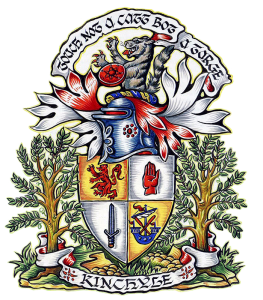
Richard McBain of McBain, 23rd Chief of the Clan MacBean
In 2021 the Scottish Register of Tartans listed ten different tartans under the names MacBean and McBain. With the help of Lt. Col. Peter Eslea MacDonald of the Scottish Tartans Authority and our Seanachaidh, Philip Beddows, we settled on four official tartans, and in 2022 we added a fifth. As Chief, I recognize these five as the tartans of the Clan MacBean, and every member of the clan may wear any of them.
Picture: the McBain Chief tartan
(Photograph (Copyright) of Hughston McBain of McBain’s kilt tartan, taken by Richard McBain of McBain and published here with his kind permission)
McBain Chief
When the Lord Lyon, Sir Thomas Innes of Learney, recognized my grandfather Hughston McBain as 21st Chief in 1960, ending some 170 years in which the clan had no chief, the threadcount of his tartan was written into his grant of arms. It is one of only a few dozen tartans the Lord Lyon has ever recorded.
It is close to the clan tartan, but the black and light blue stripes are swapped, and its stronger light blue has become known as “Hughston’s Blue”. For years it was sold as “McBain (Lord Lyon)”. I asked that its new name keep my grandfather’s spelling, McBain Chief, and that any clansman or clanswoman be free to wear it. My father’s kilt was woven to the Lyon Court threadcount, probably by Lochcarron around 1960, and in 2024 I wore it in a kilt of my own for the first time.
MacBean (Clan)
The tartan most of us wear began, oddly enough, as a pair of stockings. In the 1840s the artist Robert McIan painted Gillies MacBean, the hero of Culloden, in Mackintosh tartan, and for his hose used a pattern woven by Wilson of Bannockburn. The Victorian tartan trade took the pattern from those hose and sold it as “MacBean”.
Over the next century weavers produced many slightly different versions. Peter MacDonald traced them back to the oldest woven sample, in Clans Originaux, a book of tartan swatches from about 1880. That version is now the official clan tartan. Lochcarron also weave it in softer colors as MacBean Ancient.
Picture: the modern MacBean (Clan) tartan
(Photograph of the sample in ‘Clans Originaux’ – provided by Peter E. MacDonald)
Picture: the MacBean Dress tartan
(Photograph (Copyright) from the Scottish Tartans Authority – published with their kind permission)
MacBean Dress
The Dress tartan is a love story. Its designer, James D. “Jamie” Scarlett, was for decades the leading authority on tartan, and his wife, Meta, was a MacBean. When they were engaged he wove her an arisaid, the traditional Highland woman’s plaid, in a white-ground version of the MacBean tartan. Later he designed a similar sett so that all MacBean ladies could have “something more suitable and more historically proper to wear”.
That became the MacBean Dress. Like all dress tartans it is woven on a white ground, which shows off a Highland dancer’s footwork, with a red stripe bordered in black, the “Mackintosh stripe”, running across it. My father authorized it so that our dancers would no longer have to compete in other clans’ tartans, and first showed it to the clan in July 1990 at the Rocky Mountain Highland Games.
MacBean of Tomatin
This is the oldest MacBean tartan we know of, and it was nearly lost. For more than a century Philip Beddows’ family has owned an antique blanket in an unusual tartan: Mackintosh, with a dark line through the middle of the large red squares. From 2016 to 2018 Philip searched for its story, until Kari Moodie of Inverness Museum and Peter MacDonald found a matching swatch in the museum’s vault, from Alexander McBean & Sons, tailors of Inverness, labelled simply “MacBean”.
In 1872 Colonel William MacBean of Tomatin had confirmed it as “the one worn and recognised by himself as the Macbean tartan,” because a very ancient piece of it had been found in the house of Tomatin. The line on the red is dark blue, not black. The MacBean of Tomatin is now one of the clan’s official tartans. Read Philip’s account of its rediscovery.
Picture: the MacBean of Tomatin tartan (Photograph (Copyright) of cloth woven by Peter E. MacDonald, published here with his kind permission)
MacBean Hunting
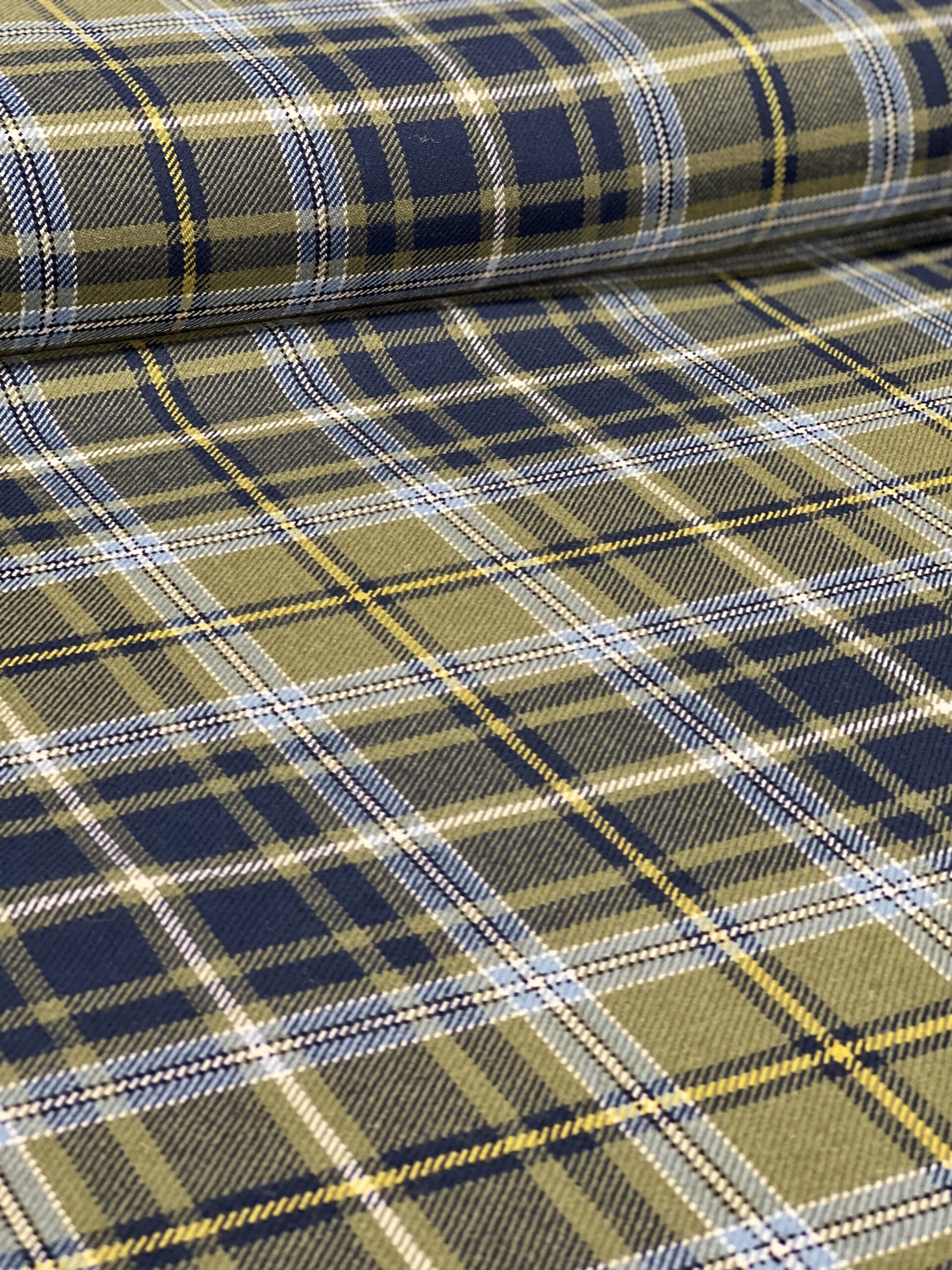
In 2019 Peter MacDonald showed us that our old “hunting” tartan was only the clan tartan woven in duller colors, not a tartan of its own, and suggested we design a real one. Philip took up the design with Peter’s guidance, and the result is a union of all the MacBean tartans: olive green from the Ancient clan tartan and the Highland hills, a special dark blue from the Tomatin, “Hughston’s Blue” from my grandfather’s tartan, a gold stripe for Clan Chattan and the Chief’s arms, and a small white cross in the blue, “a shining star far away in space”, for Alan Bean and the Moon tartan.
Lochcarron wove the first cloth in March 2022. I wore it for the first time at my inauguration on 6 August 2022, and the Scottish Register of Tartans recorded it that September. It was the first major new tartan for our clan in more than two hundred years, and the last project my father and I worked on together. To keep its colors true it is woven only by Lochcarron of Scotland, and any other weaver needs the Chief’s written permission. More about the MacBean Hunting tartan.
The Moon tartan
In November 1969 Captain Alan LaVern Bean, the fourth man to walk on the Moon, carried a piece of MacBean tartan to the Moon’s Ocean of Storms in his personal kit on Apollo 12. As far as anyone knows, no tartan has traveled further. He later gave pieces of it to my grandfather and to St Bean’s Church at Fowlis Wester, and in 1996 presented the clan with his painting Clan MacBean Arrives on the Moon, with a cutting of the tartan on its frame. Today he is remembered by a memorial in the McBain Memorial Park.
Wearing and ordering the tartans
Any member of the clan may wear any of the five tartans. All five can be ordered as cloth, kilts and accessories from ScotlandShop (the MacBean Hunting cloth they sell is woven by Lochcarron), and the clan tartan in modern and ancient colors is widely available from Highland outfitters. Members of the Clan MacBean Association are entitled to a 10% discount on ScotlandShop orders.